

Impact Windows vs. Hurricane Shutters: Which Is Better for Southwest Florida Homes?
In this article
By Tim Harwood, Owner of AGT Builders
August 2026
For homeowners in Cape Coral, preparing a house for hurricanes is part of living in Southwest Florida. Windows and exterior doors are particularly important because they are part of the building envelope and can be vulnerable to windborne debris during severe storms.
That leads to a common question: Should you invest in impact-resistant windows, or should you protect your existing windows with hurricane shutters?
When comparing impact windows vs hurricane shutters in Florida, there is no single answer that is right for every home. Both can provide effective opening protection when the products are properly rated for the application and correctly installed. The differences become clearer when you consider convenience, cost, everyday performance, aesthetics, maintenance, and how you want to prepare your home when a storm approaches.
In Cape Coral, those considerations are especially relevant in August. We are well into Atlantic hurricane season, and homeowners may be thinking more seriously about how prepared their properties are for tropical storms and hurricanes.
At AGT Builders, we have worked on construction projects throughout Florida since 2006. Our experience has taught us that hurricane protection should not be approached as simply buying a product. The product, installation, existing structure, and specific conditions of the property all matter.
Here is what Cape Coral homeowners should understand when deciding between impact windows and hurricane shutters.
Why Protecting Windows Matters During a Florida Hurricane
Before comparing the two options, it helps to understand what hurricane opening protection is designed to accomplish.
One of the major threats during a hurricane is windborne debris. Objects picked up by high winds can strike windows, doors, and other parts of a building.
If an exterior opening is breached, wind can enter the building and increase internal pressure. That can add stress to other parts of the structure.
The Florida Division of Emergency Management’s Hurricane Retrofit Guide explains that impact-resistant shutter systems are intended to protect openings from failures that could substantially increase internal pressure and to reduce the likelihood of hurricane-driven debris entering the home.
The state’s guidance also notes that protecting windows and doors is an important part of protecting the home, its contents, and its roof during a hurricane.
That is why opening protection is much more than a question of preventing broken glass.
The goal is to help maintain the integrity of the building envelope during severe wind conditions.
What Are Impact Windows?
Impact windows are window systems specifically designed and tested to resist windborne debris and the pressure cycles associated with hurricane conditions.
They typically use laminated glass. Instead of behaving like ordinary glass that can break apart and leave an opening exposed, laminated impact glazing is designed to remain held together by an interlayer even when the glass is damaged.
But the glass is only one part of an impact-resistant window.
The complete assembly matters, including:
- The glazing
- Window frame
- Sash
- Hardware
- Anchors and fasteners
- Attachment to the structure
- Installation method
This is an important distinction for Florida homeowners.
A window does not become a hurricane-resistant system simply because it contains thicker glass. The complete product must have the appropriate testing and approval for its intended application, and it must be installed according to those requirements.
The Florida Division of Emergency Management explains that impact-resistant systems are subjected not only to missile-impact testing but also to cyclic pressure testing designed to simulate the repeated positive and negative pressures produced during hurricane conditions.
For many Cape Coral homeowners, the biggest practical advantage of impact windows is straightforward: once they are properly installed, they provide passive opening protection without requiring the homeowner to cover each window every time a hurricane threatens.
What Are Hurricane Shutters?
Hurricane shutters are protective systems installed over windows, doors, and other vulnerable openings.
There are several styles available, including:
- Accordion shutters
- Roll-down shutters
- Removable storm panels
- Colonial-style shutters
- Bahama-style shutters
These systems vary considerably in price, convenience, appearance, storage requirements, and operation.
Some remain permanently attached to the home and can be closed when needed. Others require homeowners to retrieve individual panels and manually install them over each opening before a storm.
The Florida Division of Emergency Management notes that shutters can protect openings from windborne debris when the shutter system meets the appropriate impact standards.
Miami-Dade County’s hurricane-preparation guidance similarly recommends securing windows and doors with approved storm shutters or other approved methods and advises homeowners to inspect existing shutters to ensure they remain in good working condition.
See Miami-Dade County’s official guidance for preparing windows and doors for hurricanes.
Although Cape Coral is not in Miami-Dade County, the county’s hurricane-preparation information provides a useful example of how Florida authorities approach opening protection in hurricane-prone communities.
Impact Windows vs Hurricane Shutters in Florida: The Main Difference
The fundamental difference is that impact windows combine the everyday window with the storm-protection system.
Shutters add a protective system over another opening.
That distinction affects nearly every aspect of the homeowner experience.
With impact windows, the protection is already in place. You do not need to retrieve panels, close accordion shutters, or lower shutters across the house before a storm.
With shutters, preparation is generally required when a storm threatens, although the amount of work varies greatly depending on the shutter style.
A motorized roll-down shutter, for example, provides a very different experience from removable metal panels stored in a garage.
Neither approach should automatically be considered better simply because of its category. Homeowners should compare the complete systems and determine which approach fits their property and priorities.
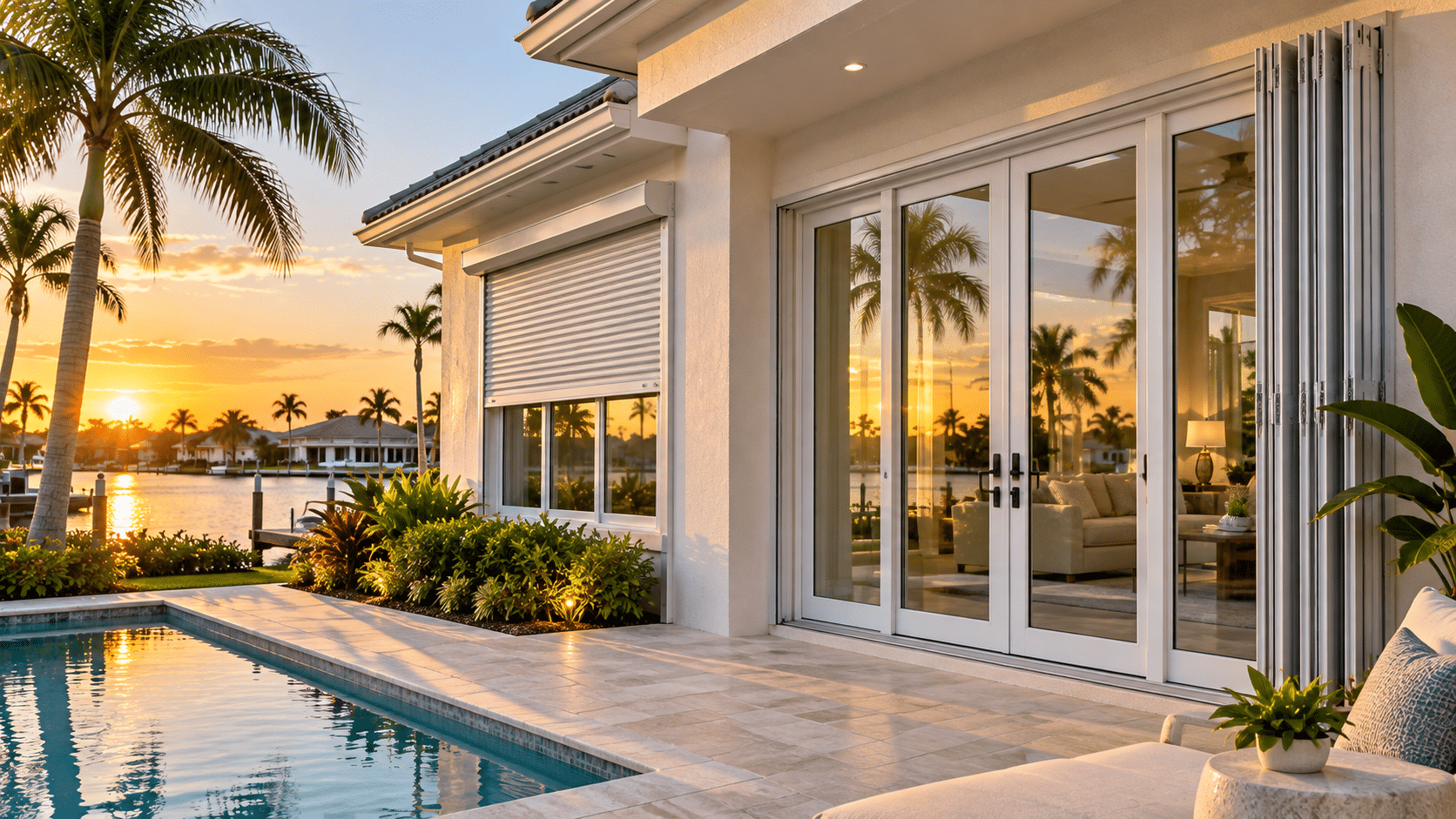
Advantage of Impact Windows: Hurricane Protection Is Always in Place
Convenience is one of the strongest arguments for impact windows.
Hurricane forecasts can change. A storm that initially appears unlikely to affect Southwest Florida can shift course, intensify, or create new concerns for residents.
With permanent impact-rated windows, homeowners do not have to install a separate covering on each protected opening every time a hurricane threatens.
That can be particularly valuable for:
- Older homeowners
- Seasonal residents
- Owners of second homes
- People who travel frequently
- Homeowners with many windows
- Homes with difficult-to-access openings
- People who do not want to physically install storm panels
For a seasonal Cape Coral resident who may be hundreds or thousands of miles away when a storm develops, passive protection can offer a major practical advantage.
The windows do not need someone to arrive at the property and install panels before the storm.
Advantage of Hurricane Shutters: Lower Initial Cost Can Be Possible
Impact window replacement is a substantial home improvement project because the existing windows are being replaced with complete new assemblies.
Shutters can offer a different financial path.
If your existing windows are in good condition and you primarily want to add windborne-debris protection, installing an appropriate shutter system may cost less initially than replacing all of the windows with impact-rated units.
The exact comparison depends on numerous factors, including:
- Number of openings
- Opening sizes
- Window styles
- Existing construction
- Shutter type
- Accessibility
- Required design pressures
- Product specifications
- Installation conditions
Simple removable storm panels may represent one end of the cost spectrum, while permanently installed automated shutter systems are a different investment.
That is why homeowners should compare actual proposals rather than assuming all shutters are inexpensive or all impact windows are prohibitively expensive.
Impact Windows Provide Benefits Every Day
This is where the comparison becomes broader than hurricane protection.
Impact windows are still your windows during the other days of the year.
When properly selected, modern replacement windows may provide benefits related to energy efficiency, air leakage, comfort, sound reduction, security, and appearance.
For example, replacing older single-pane windows with modern insulated window systems can improve thermal performance. Low-emissivity coatings and other glazing technologies can also help control solar heat gain, which is particularly relevant in Southwest Florida.
Impact-resistant laminated glass may also reduce some exterior noise compared with certain older window configurations.
These potential benefits depend on the specific product being installed. “Impact” describes hurricane-related performance, not every other characteristic of a window. Homeowners should still compare energy ratings, glass packages, frames, warranties, and other specifications.
Shutters primarily provide protection when they are deployed. They do not replace the everyday performance of the window behind them.
If your existing windows are already old, inefficient, leaking, or difficult to operate, installing shutters may protect those windows from debris without addressing the underlying problems.
That is an important consideration.
Hurricane Shutters Can Preserve Windows That Are Otherwise Performing Well
The reverse is also true.
Suppose your Cape Coral home already has relatively modern windows that operate smoothly, do not leak, and provide satisfactory energy performance, but they are not impact rated.
Replacing good windows solely to obtain impact protection may not be the only option worth considering.
An appropriately rated shutter system may allow you to retain those existing windows while adding hurricane opening protection.
This is one reason an inspection of the current windows should come before a major purchasing decision.
At AGT Builders, we believe the first question should be, “What does this house actually need?”
Not every house requires the same solution.
What About Aesthetics?
Many homeowners prefer impact windows because they preserve an unobstructed exterior appearance.
There are no storm panels covering the windows during hurricane preparation, and there may be less visible exterior hardware than with certain shutter systems.
Replacing old windows can also update the architectural appearance of the home.
Shutters vary considerably.
Accordion shutters remain visible at the sides of openings. Roll-down systems require housings above the openings. Tracks and fasteners for removable panels may also remain visible.
On the other hand, some decorative shutter styles can complement certain architectural designs.
Appearance is subjective, but it should be part of the decision because this is a system you may see every day for many years.
What About Maintenance?
Both impact windows and hurricane shutters require maintenance.
Impact windows should be inspected and maintained like other exterior window systems. Frames, seals, hardware, weatherstripping, drainage paths, and surrounding sealants should remain in good condition.
A damaged impact window should also be evaluated after a significant strike.
Remember that impact-resistant does not mean unbreakable.
The glass can crack when struck. The objective of the tested system is to resist penetration and continue providing the required protection under specified conditions.
Shutters have their own maintenance requirements.
Tracks should remain clean. Moving parts should operate correctly. Fasteners and anchors should be inspected. Removable panels need to remain identifiable, accessible, and in usable condition.
Miami-Dade County specifically advises residents to inspect existing shutters to make sure they are in good working order before they are needed.
That is good advice for Cape Coral homeowners as well.
The worst time to discover a missing storm panel, seized accordion shutter, or damaged fastener is when a hurricane warning has already been issued.
What About Deployment Time?
Deployment is one of the biggest practical differences between the systems.
Impact windows require essentially no storm-specific deployment.
With shutters, the time required depends on the system.
Roll-down shutters can be relatively quick to deploy. Accordion shutters generally require each opening to be closed and secured. Removable panels can require considerably more labor because the panels must be located, carried to the correct openings, positioned, and fastened.
Consider the number of openings on your home.
A small single-story house with accessible windows may be manageable for an able-bodied homeowner using removable panels.
A larger home with numerous windows, large sliding glass doors, elevated openings, or difficult access can be a different situation.
Also consider what happens if you are not home.
If your hurricane protection requires manual deployment, you need a reliable plan for who will perform that work when you cannot.
Can You Just Put Tape on Windows?
No.
Taping windows is not an alternative to an approved impact-resistant system or proper storm protection.
Miami-Dade County specifically states in its hurricane-preparation guidance that tape does not prevent windows from breaking.
This is a persistent hurricane myth and one homeowners should put aside.
The objective is not to draw an “X” across a pane of glass. It is to protect the entire opening using a properly designed and installed system.
Impact Rated Does Not Mean Every Product Is the Same
One of the most important lessons for homeowners comparing impact windows vs hurricane shutters in Florida is that product labels matter.
Do not assume a window or shutter is appropriate simply because a salesperson uses terms such as “hurricane rated,” “storm resistant,” or “impact.”
The Florida Division of Emergency Management warns that simply buying a new shutter, window, or door in an area requiring windborne-debris protection does not automatically mean the product is impact rated.
Florida’s Hurricane Retrofit Guide identifies recognized testing standards for impact-resistant systems, including ASTM E1886 and ASTM E1996 outside the state’s High Velocity Hurricane Zone, along with specific Florida testing protocols applicable to Miami-Dade approvals.
Products also have design-pressure limitations and installation requirements.
A product appropriate for one opening, exposure, or building configuration may not necessarily be appropriate for another.
This is why documentation and professional installation are so important.
Installation Matters as Much as the Product
A hurricane-protection system must transfer loads back into the structure.
For windows, that means the frame, anchors, substrate, and installation details matter.
For shutters, the tracks, anchors, fasteners, and surrounding construction matter.
The Florida Division of Emergency Management notes that building inspectors check whether products are installed in accordance with applicable product-approval requirements and manufacturer installation requirements.
A highly rated product installed incorrectly may not perform as intended.
Homeowners should ask contractors what product approval applies, what design pressures are required for the opening, and how the system will be attached to the existing structure.
Permitting is another consideration. Florida’s Hurricane Retrofit Guide notes that building permits are required for shutter installations and, in most situations, window and door installations.
For Cape Coral homeowners, project-specific permitting and code requirements should be confirmed with the appropriate local authorities and contractor before work begins.
What About Sliding Glass Doors?
Sliding glass doors deserve special attention in Southwest Florida.
Cape Coral homes frequently use large areas of glass to connect living spaces with lanais, pools, canals, and waterfront views.
Those large openings can also represent a substantial portion of the building envelope.
Depending on the existing system, homeowners may consider impact-rated sliding doors or an approved shutter system designed to protect the opening.
Large openings can make the convenience difference particularly noticeable.
Handling and installing multiple removable panels across a wide sliding-door opening can require significant time and effort. A permanent shutter system or impact-rated door may simplify preparation.
The right answer depends on the size, configuration, existing frame, structural conditions, and homeowner priorities.
Which Option Is Better for Seasonal Cape Coral Residents?
For seasonal residents, impact windows have an obvious advantage: protection does not depend on someone being physically present to deploy shutters.
This matters in Southwest Florida, where many homes are occupied only part of the year.
If you leave Cape Coral for extended periods, ask yourself what would happen if a hurricane threatened while you were away.
Do you have accordion or roll-down shutters that a property manager can easily close?
Do you have removable panels requiring several hours of labor?
Does someone know where those panels and fasteners are stored?
Can every opening be safely accessed?
If the answers create uncertainty, passive impact protection may be particularly attractive.
Which Option Is Better for a Home With Older Windows?
If your existing windows are approaching the end of their service life, impact-window replacement can address multiple objectives with one project.
You may be able to replace deteriorated or inefficient windows while also adding permanent impact protection.
Putting new shutters over windows that already leak, bind, have deteriorated frames, or have failed insulated glass may protect the openings during a hurricane but leave the everyday problems unresolved.
That does not automatically mean impact windows are the right financial decision. It does mean the condition of the existing windows should be part of the analysis.
Which Option Is Better if Budget Is the Main Concern?
If the existing windows remain in good condition and the primary goal is hurricane protection at a lower upfront cost, an approved shutter system may be worth serious consideration.
Different shutter types can offer different combinations of affordability and convenience.
The key is not to choose based on price alone.
A low-cost system that is so difficult to deploy that it never gets installed before a storm is not a practical solution.
Think about the entire ownership experience, including installation, maintenance, storage, deployment, and who will operate the system five or ten years from now.
Do Impact Windows Eliminate Every Hurricane Risk?
No.
Impact windows are one component of hurricane-resistant construction.
A home’s performance during a hurricane also depends on the roof covering, roof deck attachment, roof-to-wall connections, exterior doors, garage doors, wall construction, drainage, maintenance, and many other factors.
The Florida Division of Emergency Management identifies protection of windows and doors as an important part of reducing hurricane vulnerability, but opening protection does not make an entire house hurricane-proof.
Water intrusion is another concern.
The state’s Hurricane Retrofit Guide notes that wind-driven rain can enter through cracks, gaps, penetrations, and areas around windows and doors even when major building components are protected.
No reputable contractor should promise that installing impact windows will make a home invulnerable to hurricanes.
The goal is risk reduction through appropriate products, sound construction, and good preparation.
Questions to Ask Before Choosing Impact Windows or Shutters
Before making a decision, Cape Coral homeowners should ask:
- Are my existing windows still in good condition?
- Are my current windows already impact rated?
- What product approval applies to the proposed system?
- What design pressures are required for my particular openings?
- Is the entire system impact rated or only one component?
- What maintenance will be required?
- How long will it take to prepare the house for a storm?
- Can I safely deploy the system myself?
- Who will prepare the house if I am away?
- Are permits required?
- How will the product be anchored to the existing structure?
- What warranties apply to the product and installation?
- Does replacing the windows solve other existing problems with my home?
Those questions can turn what initially looks like a simple product comparison into a much more useful discussion about the property.
Impact Windows vs Hurricane Shutters: Which Is Better for Cape Coral?
For many homeowners, the decision comes down to priorities.
Impact windows may be the stronger choice when you want permanent hurricane protection combined with a window replacement project, improved convenience, updated appearance, and potential everyday performance benefits.
Hurricane shutters may be the stronger choice when your existing windows are in good condition, your main goal is adding storm protection, and controlling the initial project cost is particularly important.
There is also no rule saying every Cape Coral property must approach every opening in exactly the same way. The appropriate solution should be based on the building, applicable requirements, and the homeowner’s needs.
What matters most is that the system you select is properly rated for the application and professionally installed.
Why August Is a Good Time to Review Your Hurricane Protection
By August, Florida is well into hurricane season.
If you already have shutters, now is a good time to make sure they work. Locate removable panels and fasteners. Test moving systems. Look for corrosion, missing components, or damage.
If you are relying on older windows without impact protection, August is also a reminder to evaluate your longer-term plan.
A major window replacement project should not be treated as a last-minute hurricane preparation measure. Products may have lead times, permits may be required, and installation must be properly planned.
If you decide that impact windows or a new shutter system makes sense, beginning the process now can help you establish better protection for future storms instead of waiting until another hurricane is approaching the coast.
Talk to AGT Builders About Impact Windows and Hurricane Protection in Cape Coral
AGT Builders has completed construction projects throughout Florida since 2006. Our customers have included general contractors, developers, colleges, assisted living facilities, homeowner associations, school systems, governmental agencies, and other organizations.
Our experience includes large multi-residential buildings, university and high school facilities, businesses, public projects, and other medium to large construction projects.
That experience shapes the way we approach windows and doors.
We focus on quality products and superior execution, and we have developed relationships with companies we consider best in class. More importantly, we understand that even an excellent window or shutter system must be selected and installed correctly to become an effective part of the building envelope.
If you are comparing impact windows vs hurricane shutters in Florida, AGT Windows and Doors can help you evaluate the options for your Cape Coral property.
Whether your priority is permanent impact protection, replacing aging windows, improving everyday performance, or finding an appropriate shutter solution for existing openings, the right place to begin is with an evaluation of the home itself.
Visit AGTBuilders.com to learn more and speak with AGT Builders about window and door solutions for your Cape Coral home.
Sources
Florida Division of Emergency Management, Hurricane Retrofit Guide
Debris Impact Standards and Opening Protection
The Florida Division of Emergency Management provides guidance on impact-resistant windows, doors, and shutters, including windborne-debris testing, cyclic pressure testing, product installation, and the role opening protection plays in reducing hurricane damage.
Miami-Dade County, Weather Ready
Miami-Dade County provides official hurricane-preparation guidance covering storm shutters, impact-resistant glazing, window protection, shutter inspection, and common hurricane-preparation misconceptions.
The core technical statements in the article align with the cited government guidance. Florida’s Hurricane Retrofit Guide confirms that impact systems are evaluated for debris impact and cyclic pressure loading and warns that a newly purchased window or shutter is not automatically impact rated. Miami-Dade County also specifically states that tape does not prevent windows from breaking and recommends inspecting existing shutters before they are needed. (Florida Disaster App)
Related Insights
Do Impact Windows Lower Home Insurance in Cape Coral?
Impact windows can lower your homeowners insurance in Florida. Learn how wind mitigation inspections and opening protection credits work for Cape Coral homes.
Read Article
Impact Doors in Cape Coral That Complete Your Hurricane Protection
Impact doors in Cape Coral close the gaps impact windows leave. Learn how entry, French, and sliding impact doors complete your hurricane protection.
Read Article